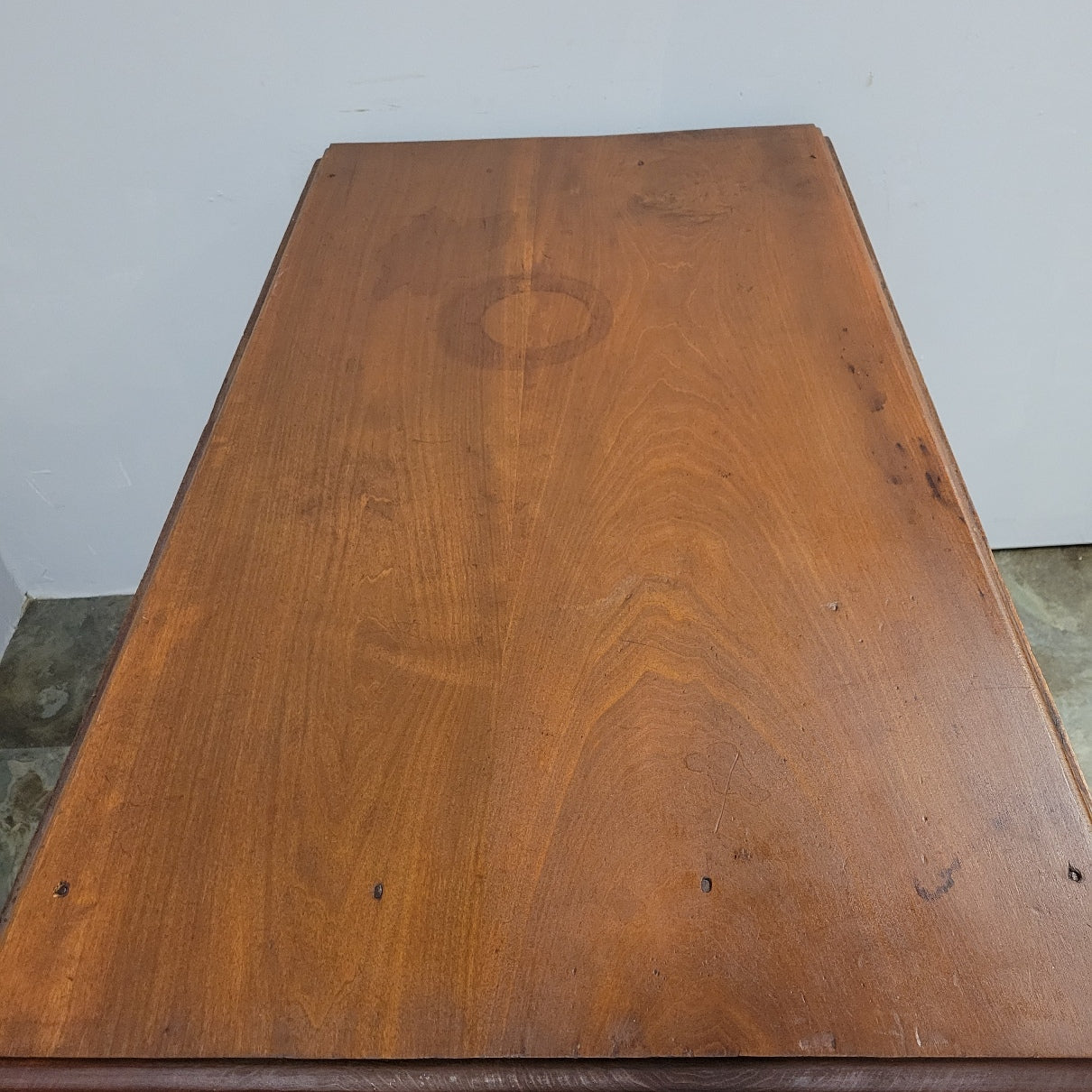
A 19th century American farmhouse drop-leaf table crafted from cherry with turned hardwood legs and traditional construction details. Tables of this form were central working surfaces in early American homes, valued for their versatility and compact footprint.
Description
The rectangular top is composed of wide cherry boards with a warm, naturally aged surface showing the rich patina that develops through generations of use. At each end, early hand-forged nails secure the boards — a detail that reinforces the table’s rural origins and practical construction.
The table rests on simple turned legs of oak or similar hardwood, providing visual contrast to the cherry top while giving the piece sturdy structural support. The drop-leaf design allows the table to adapt easily to a variety of uses. With both leaves raised it functions comfortably as a small dining or work table; with the leaves down it becomes a narrow console, sofa table, or hall table.
Wear across the surface — including scratches, small nicks, and ring marks — reflects the honest use expected of a table that likely served as a daily working surface for many decades. The visible nail heads, now recessed but exposed, add further character and are part of the authentic appeal of early farmhouse furniture.
Today the table brings warmth and practicality to an interior, working equally well in kitchens, dining areas, entry halls, or behind a sofa in a layered country house setting.
Measurements & Details
Length: 41 in
Width (closed): 22 in
Width (open): 45 in
Height: 28 in
Each leaf adds 11.5 in to the width
United States
Cherry top with turned hardwood legs
Hand-forged nails securing top boards
19th century
Wear consistent with age and use including surface scratches, nicks, finish wear, and ring stains. Nail heads are recessed but visible.
June’s Thoughts
To me, tables like this represent the quiet backbone of early American interiors. They were not made as decorative showpieces but as hardworking furniture meant to adapt to whatever the household required that day.
What I appreciate most here is the balance between utility and proportion. With the leaves raised it becomes a comfortable small dining table, yet with the leaves down the profile is slim enough to work behind a sofa or along a hallway wall. The cherry top has developed a warm patina that only comes from long use, and the visible nail heads remind you that this was built to serve a family rather than impress a showroom.
Pieces like this integrate easily into modern interiors because the design is so straightforward — simple lines, honest materials, and a sense of history that feels natural rather than staged.