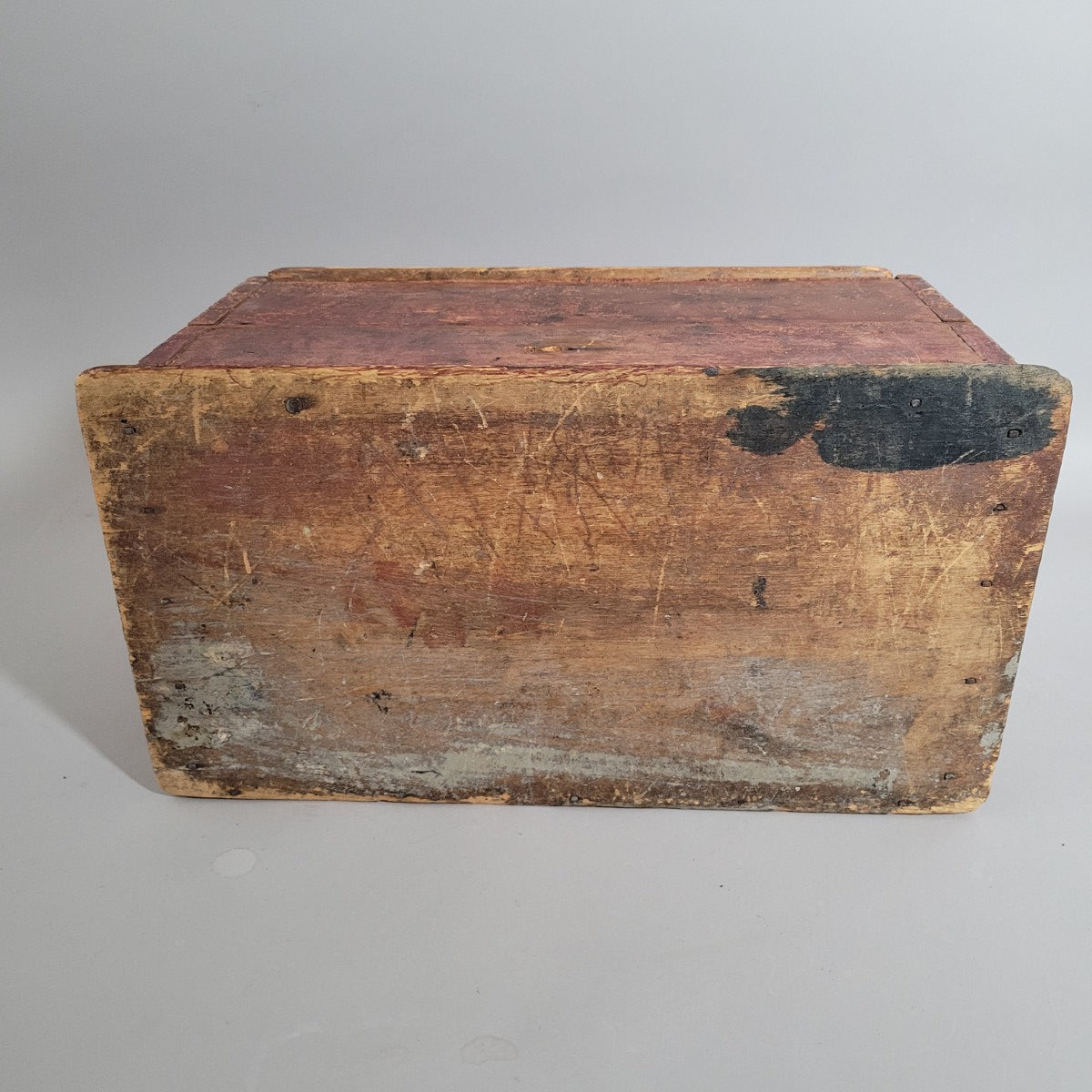
An early American wall-mounted candle box dating to circa 1800, constructed of pine with early lap joinery and cut nail assembly. Functional household forms such as these were once common in early homes, where candle boxes were placed near hearths or doorways for convenient access to lighting.
Description
The form features a tall arched backboard with hanging aperture above a rectangular candle compartment, all resting on a molded stepped base. The proportions are strong and architectural, allowing the piece to read clearly both as a functional object and as a sculptural wall form.
The sides retain traces of an early faux-mahogany grained surface executed over a warm red ground. This decorative technique was frequently applied to pine household objects in the late 18th and early 19th centuries, allowing modest materials to imitate more costly hardwood furnishings. Although now softly worn, the graining remains visible across the top and sides, offering a glimpse into the decorative ambitions of the household that once used it.
The interior shows natural darkening consistent with candle storage. The stepped base suggests the box originally included a small lower drawer, now absent. Despite this loss, the piece retains excellent visual presence and displays beautifully either mounted on a wall or resting on a surface within a layered Americana or country house interior.
Measurements & Details
Height: 12 in (measured to top of backboard)
Width: 14.5 in
Depth: 8.5 in
-United States
-Pine construction with early cut nails
-Faux-mahogany grained paint over red ground
-Circa 1800
Expected wear consistent with age and use. Lower drawer absent.
June’s Thoughts
What gives this piece its strength is not perfection but presence. The surviving grained surface — still strongest along the sides — suggests a household that valued refinement, even in a practical object.
The missing drawer does not diminish the integrity of the piece. If anything, it reinforces the sense that this object lived a long, useful life within an early American home. Hung on a wall or resting on a table, it carries the quiet authority that only early forms seem to possess.