June Hastings Collections
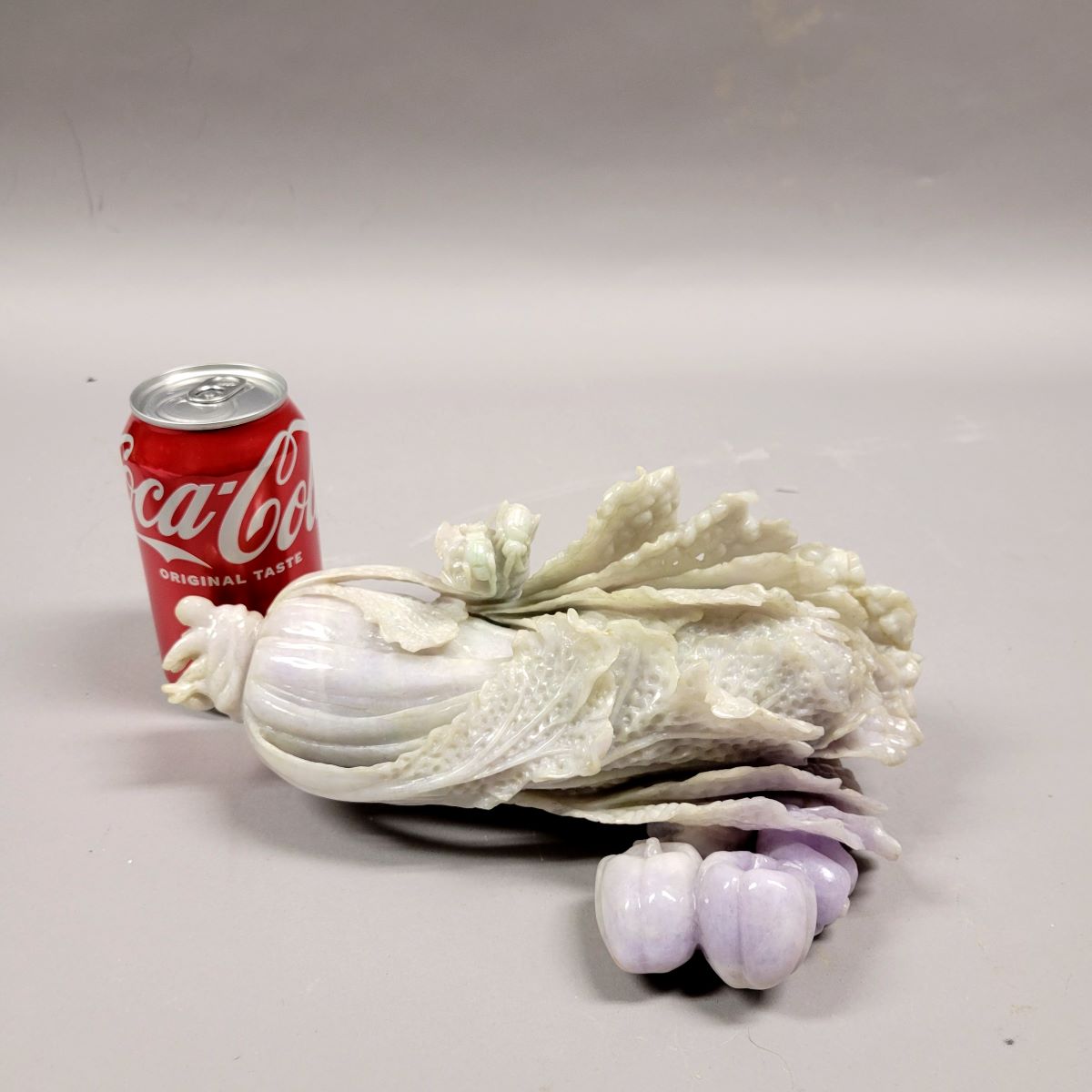
Monumental Hand-Carved Chinese Jadeite “Hundred Wealth” Bok Choy with Persimmons, 1970s
Monumental Hand-Carved Chinese Jadeite “Hundred Wealth” Bok Choy with Persimmons, 1970s
Couldn't load pickup availability
A substantial and masterfully hand-carved Chinese jadeite sculpture dating to the 1970s, depicting a luxuriant head of bok choy cradling four ripe persimmons, with delicately rendered insects resting among the leaves.
The sculptor has thoughtfully used the stone’s natural chromatic variation to dramatic effect — from milky, semi-translucent white outer leaves to softly mottled celadon and pale lavender within the stalk and fruit. The transition between colors is fluid and intentional, requiring careful orientation of the original boulder before carving began.
The carving displays exceptional dimensionality: undercut leaves curl naturally outward, textured surfaces contrast with highly polished passages, and the persimmons possess a soft, luminous glow. The surface retains the rich, hand-finished luster prized in mid-20th-century jadeite — an “oily” depth achieved only through prolonged manual polishing.
Symbolically, the composition forms an auspicious rebus. Bok choy (báicài), phonetically associated with “hundred wealth,” combined with persimmon (shì, peace or success), conveys a blessing of abundance and harmony. The insects — traditionally symbols of fertility and renewal — further enhance the theme of prosperity across generations.
Weighing approximately 5½ pounds, this is a commanding cabinet piece, equally suited to a scholar’s table, a modern pedestal, or a restrained architectural interior where material and form speak quietly but decisively.
Measurements & Details
10ʺ W × 4.25ʺ D × 6.25ʺ H
Approximate weight: 5½ lbs
Chinese, circa 1970s
No condition issues
📚 Collector’s Note
This sculpture reflects the continuation of Qing-dynasty jade carving traditions into the 20th century, particularly the reverence for naturalistic botanical subjects rendered in high-grade jadeite.
Of particular note is the successful integration of three tonal zones — white, celadon, and lavender. Multi-colored jadeite of sufficient scale to execute a composition of this size is uncommon. The artisan’s decision to position the lavender within the fruit and inner leaves demonstrates advanced planning at the block-selection stage — a hallmark of experienced workshops.
The depth of undercutting and the articulate leaf texture further distinguish it from later mass-produced carvings, which typically favor simplified surfaces and mechanical symmetry.
The Principal’s Perspective
This piece was produced at a pivotal moment — immediately prior to the widespread adoption of computer-guided carving technologies. The shaping was executed through traditional rotary carving, followed by extensive hand polishing.
The result is evident in the surface: a saturated, luminous finish with depth and warmth that cannot be replicated by automated production. Post-1980s carvings often exhibit flatter, drier surfaces and overly precise repetition in detailing.
Large-scale, multi-color jadeite carvings of this quality continue to become more difficult to source. As traditional workshop practices diminish and fine jadeite rough grows scarcer, works such as this represent not only aesthetic achievement but investment in a disappearing material discipline.
Share