June Hastings Collections
Pair of English Regency Mahogany Side Chairs with Carved Swan Splats, Circa 1820
Pair of English Regency Mahogany Side Chairs with Carved Swan Splats, Circa 1820
Couldn't load pickup availability
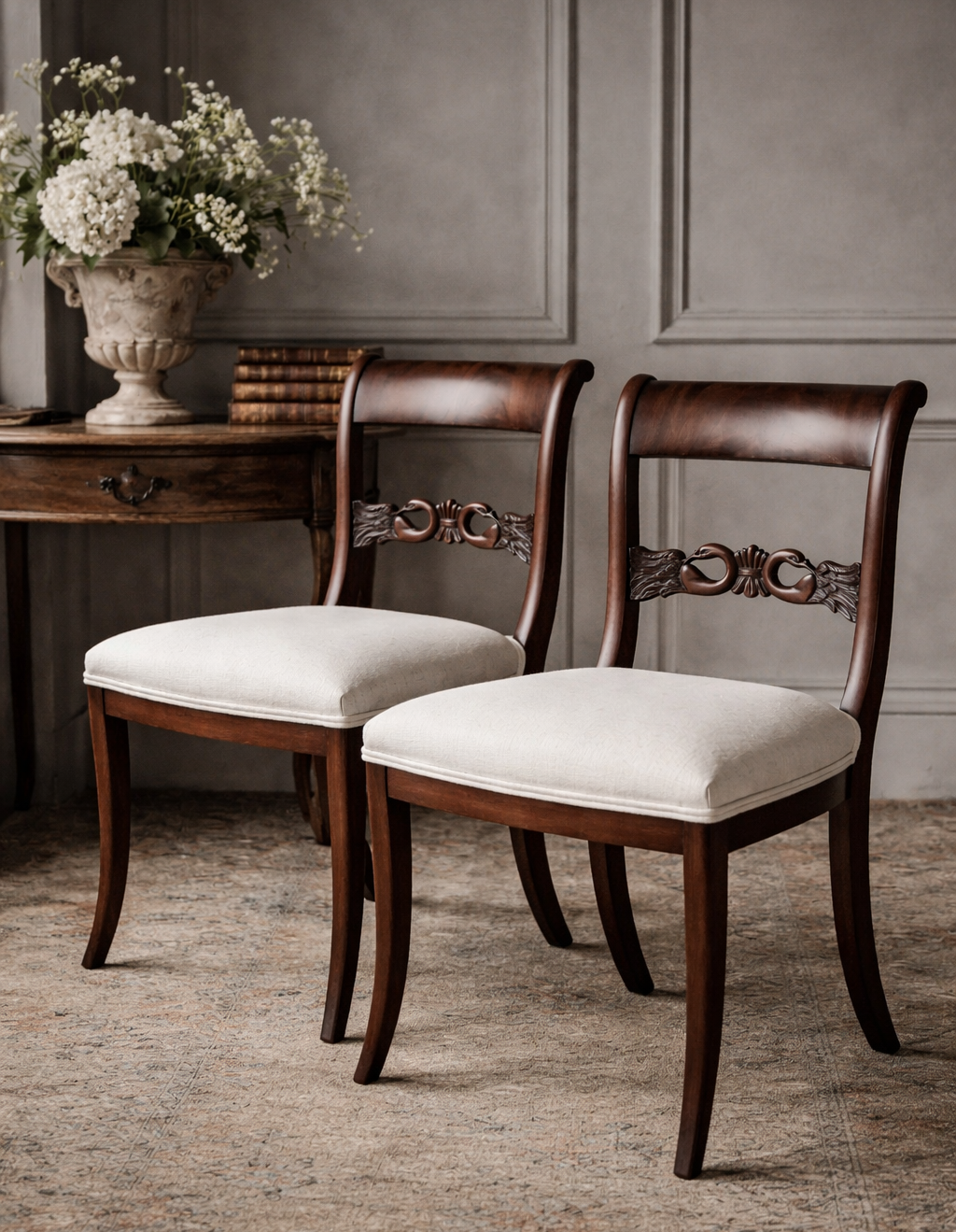
A refined pair of English Regency side chairs, crafted in figured mahogany and dating to circa 1820. Each chair features a gently bowed crest rail above a distinctive carved splat of opposing swans flanking a stylized shell—an elegant and recognizable motif of the period.
The frames are well-proportioned, with slender supports and characteristic saber rear legs, giving the pair a light, architectural presence. The crest rails retain their original mahogany veneer with rich figuring, now softly mellowed with age.
Recently reupholstered in a clean, neutral textile, the seats provide a tailored contrast to the warmth of the wood, allowing the carved detail to read clearly while making the chairs immediately usable within both traditional and transitional interiors.
A balanced and authentic Regency pair—decorative without excess, and increasingly difficult to find in matched condition.
Measurements & Details
-
Dimensions: 19.5ʺ W × 18ʺ D × 35.5ʺ H
-
Seat Height: 20ʺ
-
Origin: England
-
Date: Circa 1820–1830
-
Material: Mahogany with figured veneer
-
Upholstery: Newly upholstered in neutral fabric
-
Construction: Traditional joinery with early corner blocking
-
Condition:
-
Structurally sound and stable
-
Light surface wear consistent with age
-
Minor, stable veneer rippling to crest rail (does not affect integrity)
-
Historic evidence of inactive woodworm visible to interior frame, typical of the period
-
📚 Collector’s Note
The carved swan splat is a classic Regency device, derived from earlier neoclassical ornament but interpreted with a distinctly British softness. While American Empire chairs often rely on heavier proportions and more rigid geometry, English Regency examples—such as this pair—favor movement, curvature, and a lighter visual footprint. Surviving sets with this level of carving and proportion are increasingly scarce, particularly in usable condition.
The Principal’s Perspective
This is a disciplined acquisition at the intersection of design and investment. Early 19th-century English seating continues to be undervalued relative to continental counterparts, yet offers stronger long-term stability due to craftsmanship, material quality, and historical clarity. As decorator demand shifts toward authentic period pieces with sculptural detail, pairs like this—intact, legible, and ready for use—present a compelling entry point with upward potential.
Share