June Hastings Collections
Victorian Sterling Silver & Tortoiseshell Box, London 1888
Victorian Sterling Silver & Tortoiseshell Box, London 1888
Couldn't load pickup availability
An English sterling silver and tortoiseshell box, hallmarked London, 1888, featuring refined neoclassical silver overlay and raised on elegant hoof feet—an intimate late Victorian object with strong collector appeal.
Description
A finely worked English sterling silver and tortoiseshell box, fully hallmarked for London, 1888. The circular form is raised on three delicately cast hoof feet, supporting a body with softly worn patina consistent with age.
The lid is inset with richly toned tortoiseshell, overlaid with a precise neoclassical composition of an urn, ribbon swags, and stylized foliage. The engraving remains crisp and balanced, offering a restrained decorative vocabulary typical of late Victorian taste.
The interior retains its pale blue ruched silk lining, likely original, suggesting use for rings or other small personal objects. The scale is intimate, yet the piece carries a strong presence due to the contrast of materials and the clarity of its design.
Measurements & Notes
- 2.36" W x 2.36" D x 1.5" H
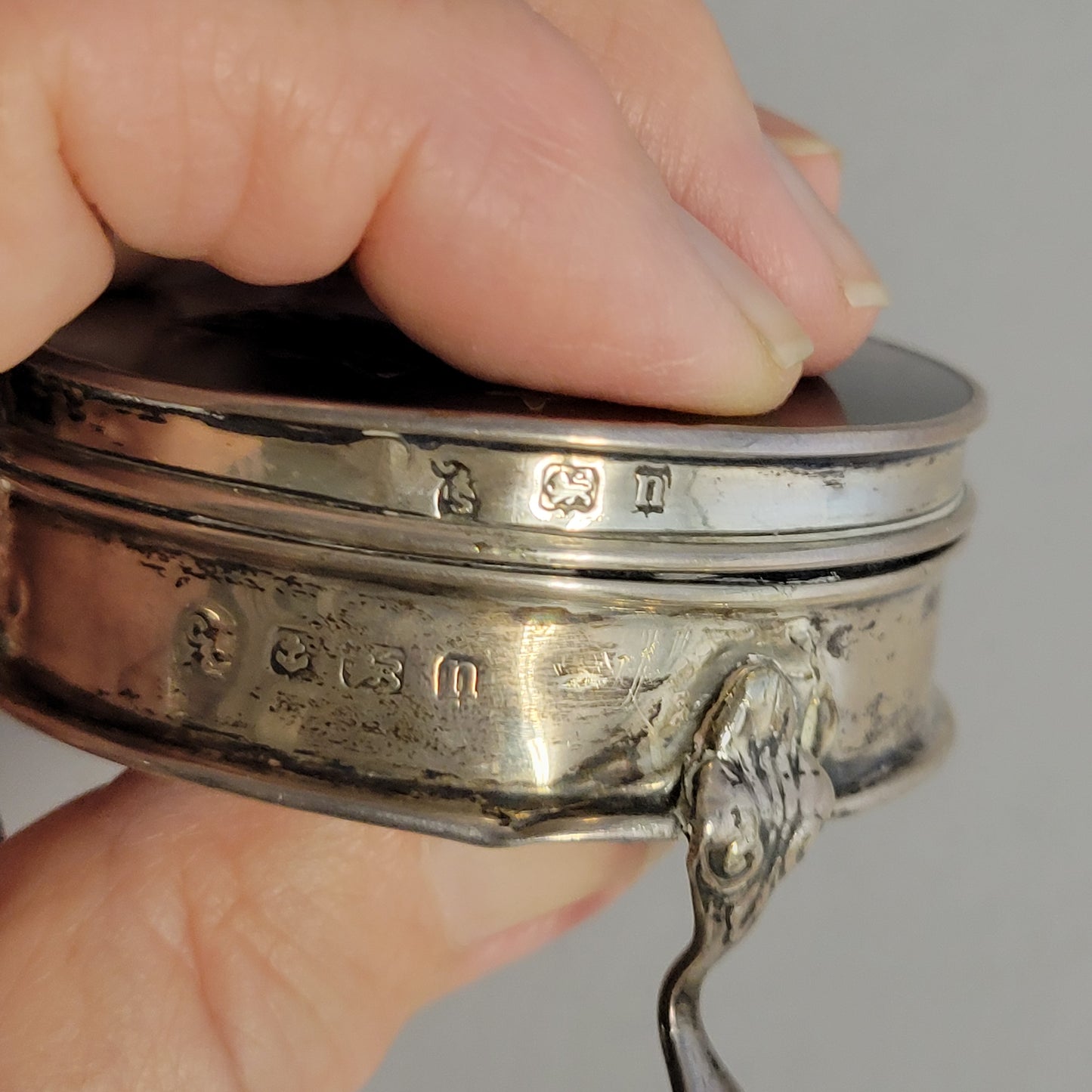
- Hallmarks: lion passant (sterling), leopard’s head (London), date letter “n” (1888), Queen Victoria duty mark, maker’s mark “C&S” (Cornelius & Sheffield)
- Materials: sterling silver, tortoiseshell, silk lining
- Origin: England
Condition
Very good antique condition.
- Slight, stable warp to tortoiseshell lid (common for the material)
- Minor dent near one foot
- Light surface wear and patina consistent with age
- Interior silk intact with gentle age-related wear
- Closes properly and remains structurally sound
📚 Collector’s Note
Boxes of this type occupy a distinct place within late 19th-century English silver, where function, material contrast, and restrained ornament were carefully balanced for a refined domestic market.
The use of tortoiseshell in combination with sterling silver reflects both aesthetic preference and technical sophistication. By the 1880s, London makers were producing small luxury objects that combined organic materials with precise silver overlay, often drawing on neoclassical motifs that had remained in circulation since the late Georgian period.
The fully struck hallmarks—including the duty mark of Queen Victoria—secure the piece within a specific regulatory and historical framework, while the maker’s mark for Cornelius & Sheffield aligns it with a known London workshop active in the production of finely finished small wares.
Examples of this scale were typically used and retained rather than discarded, which accounts for the minor distortions often seen in tortoiseshell lids over time. The present example remains well within acceptable condition parameters, preserving both its structural integrity and decorative clarity.
Share